
Leg Up
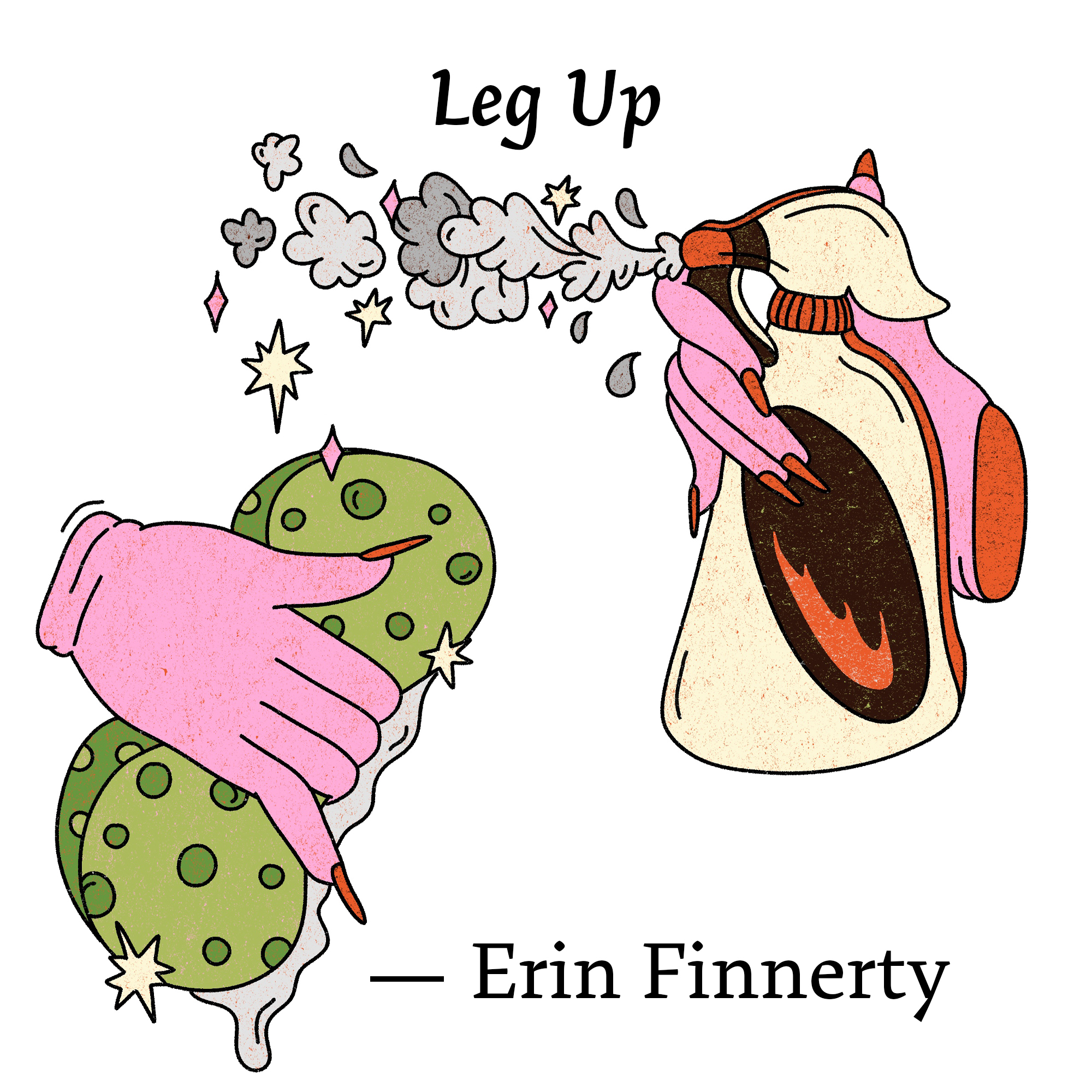
I held the pouch by the edges at first, and then circled it with my grip and squeezed lightly. The hands inside the pouch felt familiar, like other hands I have touched. They squished, the way a raw chicken breast will submit to pressure until you arrive at the bone. A revolting unease came to me. Could this be what it felt like to hold my own hands? I closed my eyes and squeezed my hand, then the hands in the pouch, back and forth for several passes, until I was sure my own hand was nothing like these things in the bag.
I unzipped the pouch and pulled the hands out. It was uncanny to touch them directly, with no plastic barrier between us. I hadn’t touched anyone besides my wife and toddler for the better part of two years.
I set the hands on the table, palms facing down, and placed mine on either side, like goalies. They were neither youthful nor old, and on the larger side. Impossible to say if they were a man’s hands or a woman’s. The nails were chipped, with some grime under them, and the knuckles were ruddy and wrinkled like five tiny foreheads. Typical for a library item, where nobody treats it the way they would their own personal property. Tragedy of the commons, etc. I leaned down and sniffed them: oniony.
I felt along the knuckles. Was there an ON switch? I turned the hands over. The fingertips pointed up like patient asparagus. I felt shy about touching the fingers, so I tickled the palms. “Yoo-hoo,” I called out, in case the hands also had ears. I tickled harder. How did people do this? Was I stupid? Or, perhaps the library was stupid, contrary to everything it tried to project.
I steadily applied pressure to the center of the palm, working my finger into the meat. The fingers snapped around mine—a momentary reflex—then released into a relaxed attention. It was clear now, they were awake.
How does one interact with any disembodied helper? It used to be through prayer, I thought. “Ok, hands, do the dishes.”
The hands levitated from the table and floated over to the kitchen sink. The right hand turned the water on, while the left checked the temperature. They commenced washing the dishes. They were thorough with the job, attacking the history of grease on the frying pan, and cleaning the blender blades with tenderness.
I sat and watched the hands wash every one of those dishes. Then, they soaped and scrubbed the basin, and rinsed all the grime down. I walked over to look. It was the first time I’d seen the bottom of the sink in months. There was a suggestion of my reflection in the sparkling porcelain. Hello, me.
I looked at the hands, and whispered: “Thank you.”
🩸
The next day, I went right ahead and ticked every box on that week’s Positive Activities for Behavioral Activation chart, and that was the last time I filled that thing out.
The doctor had said I needed to get out more, that isolation was only making things worse. If someone could see me and I could see them, I counted that as socializing. At red lights, I would look at the driver next to me, just long enough to make eye contact. I listened agreeably to a pitch about blueberry salsa at the grocery store’s sample counter. I was working my way up. My wife had taken stock of that week’s Behavioral Activation chart, so pristine and empty, and dragged me and the toddler to weekend storytime at the library. That’s where it came to me: there’s always someone at the library—nannies with babies, old people, teenagers on the computers, a guy with two suitcases fastened with dirty belts asleep at a communal table—and not one of these people is allowed to talk. It was ideal. I could be invisible, but still get credit for having done the work.
I returned on Monday, and walked up and down the shelves. There were so many books. I thought of how many millions of hours of work went into writing and publishing them, how many millions more to read them. The realization was sickening. I wanted to shut my eyes, and possibly never set foot in a library again, now that I could see it for the warehouse of endless labor that it was.
Hiding away at the rear of the stacks, I found a bin of battered, lumpy plastic pouches. Amen: a not-book. A faded label on the first pouch read DOMESTIC, and the fine print that followed beneath was worn away. Inside were two hands.
“Any particular instructions for what to do with them?” I asked the librarian at the checkout desk.
“It’s pretty self-explanatory.” She didn’t look at me, so I wouldn’t tally her in the Socialization column on my chart. I wasn’t a cheater. “Due back in three weeks.”
🩸
The hands weren’t limited to dishwashing. The more general the command, the more the hands would take on. “Ok, hands, tidy this place up.” They had a sixth sense for what needed doing. They dusted mirrors and shelves, they wiped the tops of cabinets. They folded sheets like I used to, by winding them into a squarish snowball. They wiped smudges from walls, fingerprints from the fridge, oil spatters from the stove and the wall behind the stove and the area around the garbage can. They vaporized nests of clutter that I had grown blind to.
The quality of light in my home changed. The eye could travel across a room and not be waylaid by disorder. The windows were washed free of grime, and the sun flowed once more. If my family noticed it, they didn’t say. But there was a lightness to them as well. They no longer seemed as heavy to me.
The library sent a reminder that the hands were due back at the end of the third week, with a warning that overdue materials would result in a revocation of my borrowing privileges. I tried to renew them online, but the library’s website didn’t allow for this.
I looked at the hands, where they lay stretched out on the plastic pouch on the kitchen counter. It was a mystery how they recharged. As far as I could tell, the hands also slept, finding their way back to the plastic pouch each night and staying there until morning.
The thought of them leaving me so soon was painful. The more layers of disorder they cleared away, the more aware I became of the state of neglect. A life raft had been thrown to me—I’d hauled myself on it, and soon it would dissolve beneath me.
The day came when I had to return them. But not before one last task.
“Ok, hands, clean behind the toilet.”
And one more.
“Ok, hands, wash out the garbage can.”
And one more.
“Ok, hands, roll these coins into wrappers.”
Just one more last little task, and that would be it.
I unearthed a label maker that I had bought a year ago, under the impression I’d be better organized if I labeled everything. “Ok, hands, make labels for all these jars.” The hands turned out to be terrible spellers, although precise in the application of labels.
That night, I pushed them into the plastic pouch. They were limp and curled up slightly. I drove to the library in the dark and opened the mouth of the after-hours bookdrop. Down they tumbled, into the belly of the container.
🩸
The house gradually fell into disarray again. I tried. God knows, I tried. It seemed like life wanted to compost everything in its path. What was the point in fighting it?
I thought about putting the dirty dishes straight into the garbage, and then giving up feeding my family or eating, period. Just murder-suicide dishwashing, evermore.
“What is so hard about this?” My wife had had enough. “He goes to daycare all day. What are you doing with all that time?” She was washing the dishes with the water on full blast, a Niagara of efficiency. She was still in her office clothes, sleeves rolled up. I used to wear office clothes, too. When I would go to my job, where I designed innovative solutions to digital stakeholder growth, or maybe I leveraged stakeholder solutions to drive brand innovation. The hardest part of the job was caring about the job. I got paid either way, until my company announced a new era of workforce optimization and every human being in my department was laid off. My wife noted the silver lining: now we’d have time for that baby we kept meaning to have. Having a baby was still a job—a meaningful job, with job security—that humans could do, so I took it. I was lucky to be able to do this. Plus, with all that free time, I could do something creative. Like what, my wife wondered. Like, paint a wall mural, or…become a content creator. She laughed at the idea, so I laughed at it too.
The toddler dropped pieces of banana onto the head of our geriatric cat, who sat below the table. The cat looked up at me, his eyes half shut and head wobbling slightly. Is that what I looked like? Was he making fun of me?
My wife finished the dishes, wiped off the toddler, ran his bath, and closed herself in the bedroom to answer emails. I read him a story about a turtle and a giraffe who struggle to form a friendship due to differences in height. It was heartbreaking. He sucked the thumb of one hand while gently probing his nostril with his index finger, and rubbed his bellybutton with the other hand. His marvelous self-soothing circus was a closed loop. I dreaded the day we’d have to break him of the thumb sucking and the shrapnel of his screams would no longer be contained. The first roar of his arrival out of my body had been a thrilling declaration, but the ones that followed had flattened everything in their wake.
🩸
I went back to the library the next day, and took the first two pouches of hands in the bin. Again, the librarian didn’t make eye contact with me as she booped them with her check-out taser.
For the drive home, I wedged them in the coffee cup holders, fingers pointing up. I turned the radio on. It was playing one of my favorite songs. The familiar lyrics seeped in through the cracks in my brain. I hummed along, then I sang, and then I shouted the lyrics, like a drill sergeant at karaoke. I reached over and squeezed the pouches. “You guys are going to like it at my house. There’s so much for you to do.”
🩸
I opened a cookbook, which always struck me as a depressing genre. There is no story in a cookbook except one of high expectation, hard work, and, often, disappointment. It always ends in digestion, with the fruits of one’s labor washed down the toilet.
I turned on some music, something jazzy and Latin, that made me remember people lived in other places besides this house, places where musicians made music like this—happy music. I set the hands to work prepping dinner. I let them handle the chicken, something I used to do constantly, but the feel of which I now associated with raw, peeled people. Both sets of hands were industrious, one more deft than the other, which cut itself at one point. I herded it under the cold tap and rinsed the cut. It was a minor cut, so the bleeding soon stopped, and the hands shook off the water like a healthy Labrador. I stepped in time to the music, and the hands paused to do little flair motions like salsa dancers. Or was it flamenco? I would google this factoid. Questions like these were now interesting.
When my wife got home, dinner was on the table, and the toddler was finishing his cubed hot dog and avocado. One of the hands, the one that was better with knives, was playing a little game with the toddler, slicing a banana and trying to steal the pieces. The toddler shrieked a gleeful “NO!” and shoved the banana slices in his mouth, finishing dinner in record time. I ran the bath, my wife logged off work earlier, and while the hands did the cleanup, she and I sat on the couch, a restful two feet of space between us, and watched TV. With her eyes on the set, she reached over and squeezed my thigh, her hand massaging up my leg.
I laid my hand on hers, laced my fingers into hers, and immobilized them with a squeeze. Our eyes never left the screen.
We shared a kiss that night before rolling over in opposite directions to sleep the sleep of tired parents—perpetually shallow, and never enough. It must have been around two in the morning when I came to, a gathering awareness that I couldn’t categorize. Was the toddler in the room? Or having a dream? The sound of staccato breaths stretched into moans. The moans were coming from inside the bed.
It was my wife, groaning softly, the way we used to when we were so hot for each other, and I’d find my way to her body in the dark.
She was only half awake at best, but that half was fully aroused. I listened in the dark as her moans grew stronger. The covers rustled slightly, and the bed vibrated with an accelerating pulse. She exclaimed with a resurrected joy I’d long forgotten. I watched her outline in the dark as her body slowed down and she resumed sleep.
From under the covers crept the hands. I saw them float away, back to their own place of rest.
🩸
The morning was a cliché of domestic bliss—me cooking eggs, my wife wrapping her arms around me from behind and kissing my neck. Even the toddler caught the spirit. He was contentedly holding one of the hands, sucking on one of its fingertips, using the other to smash his banana further, then licking it from the hand’s palm.
After my wife left for the day, I gave the hands their marching orders, and napped until lunch. I woke up to a faint chemical smell. I followed it to the toddler’s room. On the wall was a mural of a monster. No, a mutant. A giraffe and a turtle, welded into the same body, rendered in thick dripping strokes. Two grinning faces, one on the creature’s neck, another on its back, its head replaced with a turtle’s shell. Friends for life. A rainbow arched overhead, crafted from the dregs of our old house paint: light beige, white, a different white, dark beige, and grey. The toddler cried when he saw it that evening. My wife cradled him, speaking to him in a soothing voice while not taking her eyes off me.
🩸
Before I knew it, it was time to return the hands. There were no more available to check out, so I asked the librarian to put a hold on the maximum number of sets allowed (two).
“I’d also like to open a library card in my son’s name? We’re such a family of readers, and you know what they say about kids who grow up in a house with more than a hundred books.”
I did not actually recall what the deal was with kids whose homes have X number of books, but the librarian wasn’t listening anyway. She issued a new card which I immediately used to put a hold on two more sets of hands.
🩸
Dinnertime reached new heights. The floors were clean enough to eat off of. Technically they were clean enough to eat off of before too, since the kid did this on a regular basis and he was fine. When my wife noticed, her awe was like a cool washcloth laid on my chapped heart. “You organized my underwear drawer?” “Who descaled the coffee maker?” “Babe, did you regrout the tub?”
While they kneaded the past three years of poor sleep out of my neck and back, I imagined the hands attached to my college track coach, a man whose brutal standards and stingy praise made us compete all the more for his approval. I’d featured him in reliable masturbation fantasies for the past fifteen years. He massaged my shoulders, telling me I was the best runner, how he loved to watch me run, how he needed to see me run with my bra off, to check my form.
Just when he was also going to check if his massive cock could fit inside me, the massage stopped abruptly and concluded with a little flick on the back of my neck. I opened my eyes to see the two sets of hands floating off, the four of them huddled in a group, stiff little prigs.
That night, after the kid and my wife were finally in bed, I had them draw a bath for me, screaming hot and with a blizzard of bubbles. I could hear the rushing sound of the tap from where I lay on the couch. It reminded me of a waterfall, and waterfalls made me think about possibly wanting to actually have actual sex. I was enjoying this little movie in my mind when my arm started pulling away from my body.
One of the hands was tugging at my sleeve and gesturing to the bathroom, making a little rolling motion I knew well—hurryuphurryUP. I wanted to extend this moment of pleasure, so I took my time, taking off my robe, stretching a good stretch. The hand was a hummingbird, darting back and forth between the bathroom and me. I would not be bossed by another’s clock, though.
The tub was half full, maybe more—the gushing tap frothing up a fury of suds. One of the hands was splayed on the tub’s edge, trolling through the lather. The hand that had been hassling me pointed to the bath, a jabbing motion. Being rushed irritated me. “I get it, I get it.”
I lowered myself into the tub and closed my eyes, spreading my body and soaking up the scalding water with my own flesh. Bathtime with a baby was an entirely defanged animal—tepid water, tiny squirts of mild soap, singsong washcloth gentle touches. This bath, though: this was the real deal. Each of my nerve endings sang out with the pinch of its heat.
A hand shook me by the shoulder. I cracked open one eye. Three hands floated before my face, all pointing down at the water. The headcount belted me in the gut. I shot up, leaving a churn of suds, and groped around the tub on my knees. A panic that had been so deeply instilled from the moment of giving birth, and honed with every bath that was just one careless mistake away from being fatal, took over. The hands were beside themselves.
I found the missing fourth hand, pinned near the drain, where it had become tangled in a chain and held under by the force of the tap. I set it on the bathroom floor, and the other three hands surrounded it, patting and poking and pushing, the only things fingers can do. After a few minutes, two of them gave up, and spooned each side of the motionless hand like a pair of parentheses. The third hand was pinching now, then pounding with a balled-up fist. Eventually this hand too went still, laid on top of its partner, and interlaced fingers.
I didn’t know my place. I tiptoed to the tub, and pulled the plug. The sucking, gurgling noise of draining water nauseated me. I turned away and dried myself off, facing the corner of the bathroom. The hands were still there when I switched off the light and went to bed.
🩸
After two hours of staring into the dark, I slid out of bed, dressed, and drove to the library. I pushed both bags of hands into the after-hours bookdrop bin.
🩸
A few weeks passed. The house dulled, the food suffered, my bed had its own stubborn gravitational field. My wife sighed. I could read her mind: not this again.
I went back to the library. After touching this or that book spine for twenty minutes while waiting out my jackrabbiting heart, I went to the hand bin. Just to see what they had available. Just browsing, just curious.
There was one set, no label. They didn’t look familiar to me. I’d know my hands anywhere.
I checked them out, relieved the regular librarian wasn’t there. I went through a pantomime with the substitute librarian, told her I didn’t even know the library had hands in the catalog, how unusual. The librarian never looked up from her computer as she reviewed my account, and told me I had a fine to pay for lost library materials. It was surprisingly cheap.
Soon enough, the house was restored to its blemish-free state. The work was so perfect, it erased all signs of itself. These hands kept to themselves—no salsa dancing, no massages. If I came upon them doing work, I pivoted and went somewhere else in the house. They were so unobtrusive, it was easy to forget they were there. My wife nearly sat on one of them, until my yelp alerted her. Only once did I find them not actively working— one of them was hovering above my laptop, as the other floated quietly around the room.
I was on the toilet one day, resurfacing from an Instagram fog of women holding their clean, smiling children, wrapped in hand-knit blankets of woven cloud, when I noticed some trash in the little alley of space between the sink and the bathtub. Annoying. The hands were nowhere in sight, or at least nowhere in sight in the bathroom, since I closed the door when I had hands at home. I crouched on the floor for a closer look at what had fallen down there.
A stub of a burned birthday candle, a hard candy in its shiny wrapper, an old earring that I never wore, a half-empty tube of lotion, the toddler’s baby fingernail clippers, and a tiny origami hand, made from a page of my son’s book about the sad giraffe. These items were arranged in a semicircle, near the edge of the tub. I gathered them up and put them in the bathroom trash. Then I emptied that trash into the kitchen trash, and hauled it all out to the bin on the curb.
That evening, as the hands whizzed by, I reached out, trying to slow them down, maybe offer them a massage. They reared up in a claw for a split second, before continuing on their way, cleaning up food the toddler had dropped on the floor for the dozenth time that day.
That night, the same dream ran again and again: I’d wake to find the hands hovering over my hands, touching my hands, somehow communicating with my hands. Unable to stay submerged in sleep, I went to pee and bent down to drink from the bathroom faucet. Before I straightened up, I spotted it between the sink and the tub: a tan hand, illuminated by the small flame of a birthday candle melted to the floor. The hand was sculpted from mashed avocado oxidized brown, mixed with strands of my sandy hair. My grip split the hand open, revealing a living green center, as avocado oozed between my fingers.
🩸
I pulled on latex gloves and packed the hands up the next morning. At a stop light on the ride to the library, I angled the rear view to look at the pouch on the back seat. They lay there, inert. I kept an eye on them for the rest of the ride.
🩸
I applied myself, I really did. The cleaning, the cooking. The thankless tasks. I told myself that this was just life. Not to be afraid of hard work. I tried to recall the religion that told its followers that work was a way to worship God. Maybe that was all religions, though. Anyway, I didn’t believe in God.
I was in a good place, a solid place. I was getting up each day, getting the things done that needed doing, and a couple of smaller things just for ha-has. I ignored the notifications from the library that the other hands I’d reserved were now available. And so the days went.
🩸
I went back to the library a month later. I wasn’t going to go nuts, I just wanted to see what they might have in stock.
There was one set of particularly small hands. I made no idle chitchat with the librarians. Their judgement no longer troubled me.
I put the hands into the toddler’s room. Or, more specifically, in the toddler’s closet, but I ran a nightlight under the door. No scullery work for these hands, with their small, nimble fingers. I showed them the box of supplies and the instructions. The chubby index finger squeaked along the sheet of paper, making out the directions.
One week later, I opened the closet and there it was: a hand-knit baby blanket of woven cloud. The hands were curled in a small heap on top, like sleeping puppies. I nudged them off and they rolled onto a stack of old beach towels without stirring.
I showed the toddler the blanket, mimed for him how soft it was, by rubbing my cheek against it and closing my eyes in ecstasy. He clamped onto the edge and pulled. No, no, no—no pulling—I explained to him. He screamed like a demon and pulled harder. I pried his dirty hands off, and smoothed the blanket as best as I could, swiping at the Cheerios that were now ground into the handknit fibers.
My wife noticed the blanket that night. “How much time did you spend on this? You know he’s just going to destroy it.”
“If he does that, I promise we can give him up for adoption.” I looked up from my phone to share the joke with the toddler in his high chair. He was flapping his arms, his eyes filling with tears. He flapped faster and harder, trying to shake something off. Both of his hands had been swaddled into stumps with ace bandages.
I swept him up, tugging off the bandages and trying to soothe him. I was terrified he’d cry out and my wife would see, but I was also terrified of what neither of us could see, which was the hands. Where the fuck were they?
My wife was still in disbelief as she shouted from the bathroom over the sound of the running bath. “What does baby alpaca yarn cost, anyway? And why the hell did you do this?” She returned, holding an empty package of hot dogs and a hand-shaped sculpture formed from two knitting needles.
🩸
That night, I opened my laptop, but couldn’t unlock it. My password didn’t work and neither did my fingerprint. I tried every variation I could think of, and triggered a complete lockdown. The same thing happened with my phone. I was enraged beyond all reason. I would have to call the geniuses in the morning to fix this—that is, if I could figure out how to call them when I couldn’t actually use my phone.
With all digital entertainment off limits, I figured I’d do myself a favor and go to bed on the earlier side. My wife and kid were already asleep. Maybe they were onto something with the whole set bedtime thing.
I stood in the bathroom, facing the mirror, preparing to brush my teeth. I knew what the steps were: open the medicine cabinet, take out the toothpaste and my toothbrush. My hands were filled with concrete, though. They simply refused. I thought I was having a stroke, but I kept my eyes on my eyes in the mirror. I was still me, I was still in there.
With tremendous effort, I lifted my arm. It yielded to force, and then my hand was hovering in the air in front of my face. It turned, the pads of the fingertips facing me, but I did not know these strangers. The fingers jerked over my head, gripped my hair, and yanked my head down. My forehead and cheek hit the sink, and were held fast there. My one free eye clutched at all it could see. On the floor, at the base of the tub, a latex glove, packed tight with something restless. The glove ruptured, and out twitched and slithered segments of hot dog, now stacking atop each other, forming a tower, hand over hand, up the side of the tub, toward me.
🩸
Dear Town Libary,
I regert to inform you that I have lost the Hands that i recently checkd out. Its all my fault. Please charge my credit card nine hindered dollars for the replacement fee. And please cansel all my libary cards so I can never check anything out again.
Thank you for the home you pervide for so many helpfill resourses.
The Hands especially wormed my heart.
Sincerly yours,
H.
Erin Finnerty writes speculative fiction. Her work has appeared in Does It Have Pockets, Bog Fancy: Tales from the Dank, and Mobius Blvd and is forthcoming in The Forge.